

In recent months, the capital that tends to anticipate innovation cycles has pointed to a new place. Sequoia Capital published the thesis that the next wave of value does not come from adding artificial intelligence to existing software tools, but from rebuilding entire processes natively around AI. The distinction the thesis draws is between copilot and autopilot: a copilot sells a tool, placed in the hands of a professional who remains responsible for the process the way it has always operated; an autopilot sells the outcome of the work itself, delivering the final result without preserving the old workflow behind it. Y Combinator reinforced the same movement by opening a call for companies described as AI native agencies, built to deliver service outcomes without inheriting the traditional human process that would normally sustain that service. This is no longer a thesis about the future, it is a new model of capital allocation already underway. If the last 25 years were the SaaS era, the industry is now entering the era of AI powered service companies, the AI Native Agencies. This is the new investment thesis behind many Silicon Valley funds. And it means, beyond simply adopting LLMs, reshaping corporate processes around the capabilities of artificial intelligence.
Action Labs’ next Insights de Sexta will cover AI adoption workflows inside corporations. Want to join? Learn more here.
Simply bolting AI onto a process that stays structured the old way does not capture that kind of value. Putting a copilot on top of one isolated stage, without rebuilding what comes after it, just delivers a faster version of a process that still empties into the same old bottlenecks.
Accelerating one stage with artificial intelligence does not accelerate the whole process or increase the outcome
Real process optimization with artificial intelligence only translates into business gain when the acceleration reaches every stage of a corporate process, from the start through to final delivery. Accelerating a single stage, without accelerating the stages that follow, does not eliminate any bottleneck. It only moves the point where work piles up, shifting the process’s critical path to the next stage, which keeps running at the old pace.
The clearest image for this idea is a highway. Widening the beginning of a road without widening the rest of the route does not increase the number of cars reaching the destination per hour. It only increases the number of cars stuck in the next stretch, where the road stays narrow. The maximum throughput of the entire highway is still defined by its slowest stretch, not by the stretch that got widened. This is the same principle behind the Theory of Constraints, formulated by Eliyahu Goldratt: every system has a single factor that currently limits its overall performance, and optimizing any point outside that factor does not move the needle on the final result.
The same reasoning applies to any corporate process. If one stage is accelerated by artificial intelligence but the next stage still depends on human interactions the same way as before, total process time does not change in any meaningful way. What changes is only the point where work accumulates while it waits to be processed. A company can invest heavily in automating a handful of stages and internal processes and still feel no noticeable improvement in revenue generation, cost savings, or final delivery time to the customer.
A framework for prioritizing where AI enters corporate processes
The Theory of Constraints already offers a tested roadmap for deciding where to invest inside a process: Goldratt’s five focusing steps. Applied to inserting artificial intelligence, they gain one additional layer that runs across all five: the digital maturity of each stage of the process, decisive for knowing whether that stage can be measured, tested, and improved with precision, or whether it needs to be digitized first.

Before applying the five steps to a specific process, the first choice is which process deserves this analysis first. Processes that directly affect revenue, cost, or risk at scale justify this attention investment ahead of processes confined to a single area, even when the technical complexity of automation is similar.
- Identify the constraint. Map the process from start to finish and locate the stage that currently limits total delivery time, not the most visible, most recent, or most easily “turned into a prompt” stage. The digital maturity layer matters most here: stages that already run on structured data are easy to diagnose with precision; stages still dependent on paper, loose spreadsheets, or unrecorded verbal decisions hide their real contribution to the delay, and often need a digitization effort before any reliable diagnosis is possible.
- Exploit the constraint. Before investing heavily in automation, extract the maximum from the identified stage using what already exists, adjusting rules, priorities, and workflows around it. This is usually where artificial intelligence enters first, applied exactly at the stage currently holding up the process, not at the stage that is easiest to automate.
- Subordinate everything else to that decision. A fundamental factor comes in here, one that is also part of the Prioritization stage of PoC Design: radically honest analysis of where AI experiments, however easy to implement, should not be pursued. It is the old maxim that knowing what not to do matters as much as knowing what to do. In this context, the stages before and after the constraint need to run at its pace, not at their own isolated pace. Accelerating any stage outside the constraint, in other processes, at this point, is the mistake of widening the beginning of the road without widening the rest of the route.
- Elevate the constraint. Only after it has been exploited and subordinated does the identified stage receive investment to genuinely expand its capacity, which can include rebuilding that stage natively around artificial intelligence, rather than simply speeding up the old workflow on top.
- Repeat the cycle, without letting inertia become the new constraint. Once one constraint is resolved, another stage becomes the bottleneck. The cycle restarts from step one, and the digital maturity gained in the previous round makes diagnosing the next constraint easier. Treating the first improvement as final is the most common reason an initial efficiency gain stops repeating itself.
Artificial intelligence in corporate innovation cycles
The same reasoning applies directly to innovation processes inside a company. Investing in accelerating the ideation and opportunity assessment stage, making it faster and more abundant in project proposals, does not increase a company’s innovation capacity if the next stage, prototyping and market testing, keeps running at the same pace. The practical result is a growing queue of good ideas waiting to be prototyped and tested, with none of them reaching the market any faster. In the same way, speeding up “screen creation” (with tools like Lovable or other AI powered website builders) does not increase the throughput of new digital products, if the process for analyzing the journey and validating value delivery to the user does not also gain a new dynamic. Quite the opposite, it increases a company’s ability to build many things faster, without knowing whether they are the right things to build.
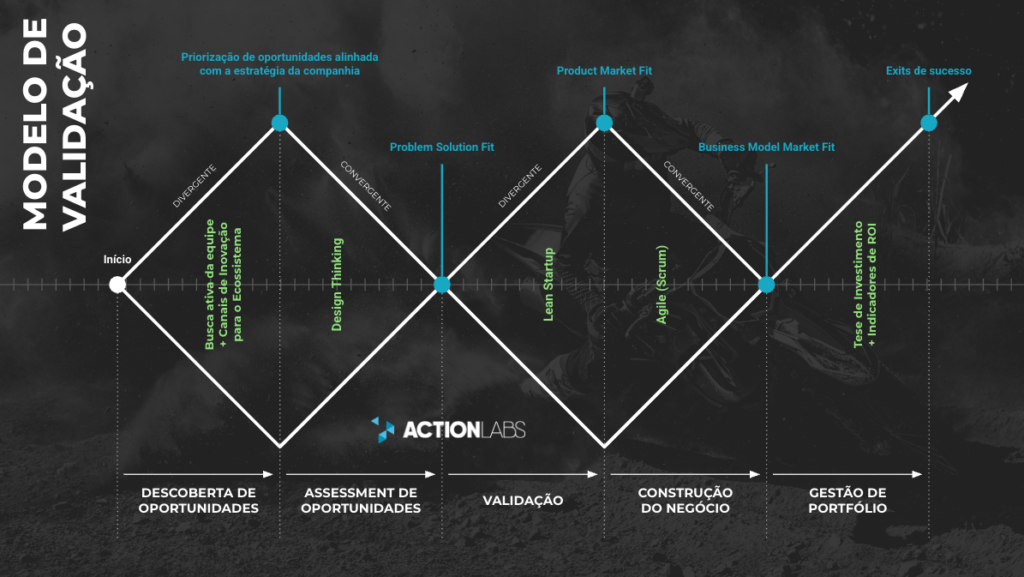
Before accelerating idea generation, it makes more sense to ask where the innovation funnel is actually stuck. It is usually not in the volume of opportunities identified, but in the capacity to turn those opportunities into testable prototypes and real pilots, assess consumer behavior, and validate the value proposition. Investing in workflows that increase final delivery capacity, prototyping, validation, and piloting, has a far bigger effect on a company’s innovation output than investing only in the early stages, which are rarely the factor limiting growth.
There is no magic in accelerating a single stage of a process, and no function gets automatically replaced. There is a complete mapping of the process, from start to finish, before any decision about where artificial intelligence enters. That mapping is the same kind of structured discovery that underpins any well built innovation project, and it is what separates companies that feel the efficiency gain in practice from those that just move the queue somewhere else.
Action Labs’ next Insights de Sexta, its innovators gathering, will explore this topic in depth and discuss practical workflows for adopting artificial intelligence within corporate structures. Interested? Learn more here.